From Corrosion to Confidence: Composite Pipe Repair Systems That Restore Pipeline Strength and Minimize Downtime
Pipeline operators face constant pressure to keep critical assets online while managing corrosion, wall loss and mechanical damage safely and cost-effectively. Traditional welded repairs can introduce hot work, extended shutdowns and added complexity, especially for in-service lines and hard-to-access assets.
Denso’s Composite Pipe Repair Systems, including Protal 3200CF and Protal 2800CF, deliver advanced, non-metallic pipeline repair solutions designed to restore structural integrity and minimize operational disruption. By combining carbon fiber reinforcement with performance-driven epoxy systems, these composite wraps create a durable, load-bearing layer that works with the existing pipe to extend service life.
Why Non-Metallic Composite Pipe Repair?
Denso’s composite pipe repair systems are designed for non-through-wall pipeline defects where corrosion, wall loss or mechanical damage has reduced structural capacity, but full replacement or welded sleeves may not be practical. They offer a non-metallic, standards-based alternative to traditional welded repairs, helping operators avoid hot work while addressing structural needs.
Designed in accordance with ASME PCC-2 Art. 401 and ISO/TS 24817, these systems support a consistent, standards-based approach to non-metallic pipeline rehabilitation and help owners, engineers and contractors integrate composite repairs into broader integrity management programs.
Where Denso Composite Pipe Repair Systems Are Used
Denso’s composite pipe repair solutions are engineered for a wide range of industrial and energy infrastructure applications, including pipelines, process piping, offshore topside piping, oil and gas risers and pressure vessels. Because Protal 3200CF and Protal 2800CF can be installed on in-service pipelines, operators can complete structural repairs while helping reduce downtime and avoid the complications associated with traditional welded repairs.
For above-ground, UV-exposed applications, the cured composite can be topcoated with Archco 15 or Archco 65, while optional Denso ViscoWrap or Densyl Tape can be added when project specifications call for additional mechanical or environmental protection.
Protal 3200CF: High-Strength Composite Repair for Critical Pipelines
Protal 3200CF is Denso’s high-strength composite pipe repair system, engineered for operators seeking strong mechanical reinforcement in critical pipeline applications. The system combines dry carbon fiber fabric with Protal 3220 Epoxy Saturant, Protal 7200 Corrosion Barrier Epoxy and Protal 3210 Load Transfer Filler.
Protal 3200CF delivers tensile strength of 114 ksi and an elasticity modulus of 9.32 Msi, providing a robust, load-bearing composite laminate for non-through-wall defects. Protal 3210 Load Transfer Filler fills pits, dents, corrosion cavities and irregular surfaces so loads can transfer efficiently from the host pipe into the composite repair.
Protal 7200 Corrosion Barrier Epoxy is applied beneath the wrap to help protect the repair zone from future corrosion, while the wet-out application of the carbon fiber fabric with Protal 3220 Epoxy Saturant supports controlled laminate quality and repeatable installation performance.
Protal 2800CF: Moisture-Tolerant Composite Repairs for Wet or Sweating Pipelines
Protal 2800CF is designed for operators who require quick, moisture-tolerant composite pipe repairs on pipelines and piping systems where perfectly dry conditions are not practical. The system uses Protal 7300 Corrosion Barrier Epoxy, Protal 3210 Load Transfer Filler and a pre-impregnated carbon fiber wrap supplied in a nitrogen-filled foil pouch.
The wrap is activated by a continuous light water spray, which simplifies field installation by eliminating the need for a separate wet-out table and resin saturation step. Protal 7300 can be applied to wet or sweating surfaces, where it displaces water as the coating is installed, helping crews complete repairs when condensation or moisture is present.
Protal 2800CF provides tensile strength of 66.1 ksi and an elasticity modulus of 6.93 Msi, giving operators a structural repair solution that balances mechanical performance with application flexibility in the field.
Surface Preparation, Standards and Installation Best Practices
Both Protal 3200CF and Protal 2800CF are designed in accordance with ASME PCC-2 Art. 401 and ISO/TS 24817, supporting standards-based composite repair designs. Ideally, both systems require near-white metal surface preparation in accordance with SSPC-SP10 / NACE No. 2 to support proper adhesion, installation quality and long-term performance.
Denso composite pipe repair systems are installed by certified personnel to help ensure consistent application and reliable service life. Each system can also incorporate Denso ILI markers between wrap layers to help identify repaired areas during future in-line inspections and support integrity management and inspection planning.
Operating Conditions and Environmental Protection
Denso’s composite pipe repair systems are designed for deployment across a broad range of field conditions. Both Protal 3200CF and Protal 2800CF can be installed from 50°F to 120°F and are rated for a maximum operating temperature of 140°F.
For above-ground applications where UV exposure is a concern, the cured composite may be topcoated with Archco 15 or Archco 65, and optional Denso ViscoWrap or Densyl Tape can be added when project specifications call for additional mechanical or environmental protection over the composite wrap.
Choosing the Right Composite Repair System
Protal 3200CF delivers high‑strength, engineered laminate performance for critical pipeline reinforcement, while Protal 2800CF provides a moisture‑tolerant composite option that simplifies installation on wet or sweating lines and helps speed repairs in demanding field conditions.
Together, these non-metallic composite pipe repair systems enable specifiers to match the repair approach to the asset, environment and application need while maintaining a standards-based composite rehabilitation philosophy.
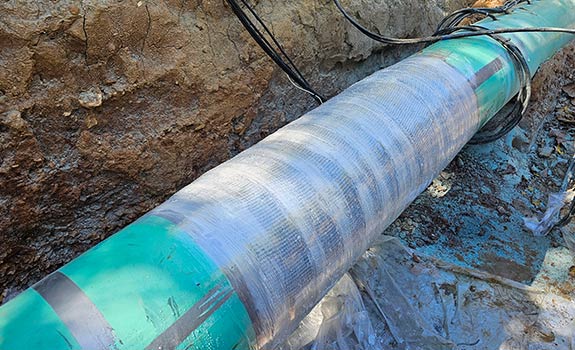
Denso’s Composite Pipe Repair Systems reinforce damaged pipelines with high-strength carbon fiber while providing long-term corrosion protection.